
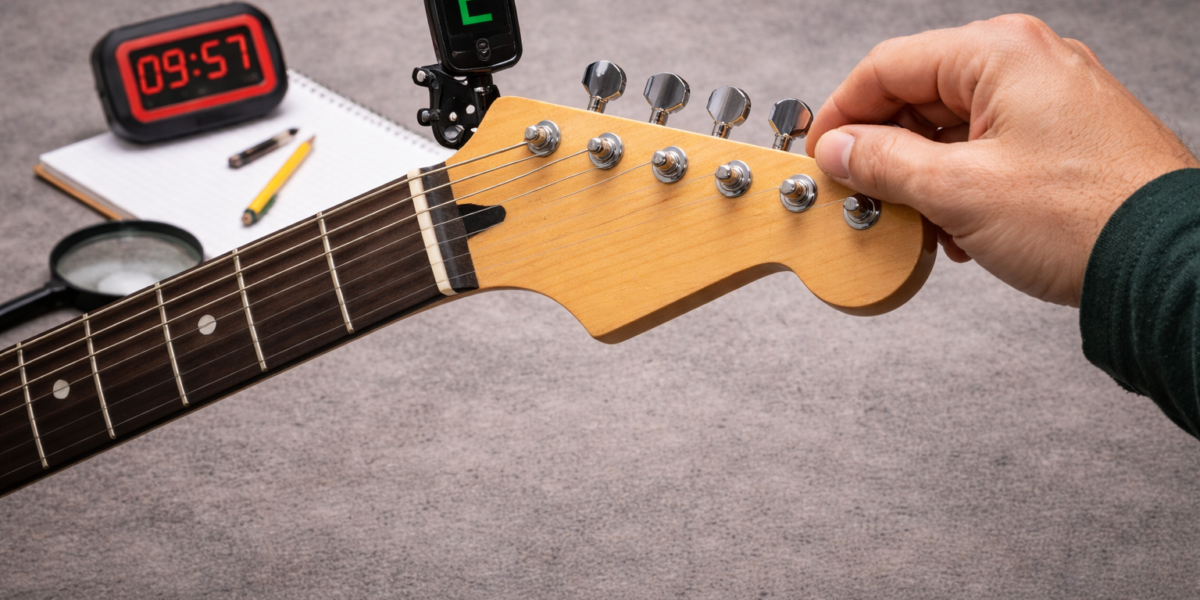
A proper electric setup makes everything easier: bends feel cleaner, chords fret easier, tuning is more stable, and intonation stops fighting you above the 5th fret.
This guide covers a standard steel-string electric with either a fixed bridge or tremolo.
Tools You’ll Need
- Capo
- Feeler gauges
- String action ruler
- Correct hex keys/screwdrivers
- Tuner (strobe or accurate chromatic preferred)
- Radius gauges (optional but useful)
Before You Start
- Install your preferred string gauge first
- Tune to pitch before each measurement
- Do setup in this order:
Relief → Action → Nut → Pickup Height → Intonation
Step 1: Set Neck Relief
- Capo the 1st fret.
- Fret low E at last fret.
- Measure gap around 7th–8th fret.
Starting target (electric):
0.004″–0.008″ (0.10–0.20 mm)
- Too much relief: tighten truss rod slightly (clockwise)
- Too little/backbow: loosen slightly (counterclockwise)
Make tiny moves (1/8 turn), retune, and re-check.
Step 2: Set Action at 12th Fret
Starting point:
- Low E: 1.75–2.0 mm
- High E: 1.25–1.6 mm
Adjust with bridge saddles (or bridge posts, depending on model).
Match the fretboard radius as you fine-tune middle strings.
If you play hard, raise slightly. If you play light, you can go lower.
Step 3: Check Nut Slot Height
Fret each string at 3rd fret and inspect clearance over 1st fret.
- Tiny clearance = good
- Too high = stiff first-position feel, sharp intonation on open chords
- Too low = open buzz
Nut work is easy to overdo. File very slowly.
Step 4: Set Pickup Height
Press last fret, then measure pickup-to-string distance.
Safe starting range (varies by pickup type):
- Bass side: ~2.0–2.5 mm
- Treble side: ~1.5–2.0 mm
Too close can cause warbling/stratitis (especially neck pickup on bass strings).
Too far sounds weak/thin.
Adjust by ear after baseline.
Step 5: Set Intonation
For each string:
- Tune open string exactly.
- Play fretted 12th fret note (not harmonic).
- If fretted note is sharp → move saddle back (increase string length).
- If flat → move saddle forward.
Retune after every saddle move.
Step 6: Tremolo Check (if applicable)
For Strat-style floating trem:
- Ensure bridge plate sits at your preferred angle (decked or floating)
- Balance spring tension vs string tension
- Recheck tuning stability after bends and vibrato use
For hardtail/fixed bridge: skip this step.
Step 7: Final Play Test
Test:
- Open chords
- Barre chords up neck
- Bends at high frets
- Palm-muted riffs
- Aggressive picking
Tweak in tiny increments until it feels right for your playing style.
Common Setup Mistakes
- Large truss rod adjustments
- Setting action before relief
- Forgetting to retune between changes
- Chasing ultra-low action with uneven frets
- Ignoring pickup height’s effect on tone/tuning
If your setup still isn’t dialed in, check one of the detailed guides on this site before making bigger adjustments:
- How to Do a Basic Acoustic Guitar Setup
- How to Set Up a Steel-String Electric Guitar
- Nut Slot Height: Common Mistakes and Fixes (if/when published)
- Truss Rod Adjustments Explained (if/when published)
- How to Diagnose Fret Buzz by Position (if/when published)
These step-by-step walkthroughs go deeper than the cheat sheet and help you troubleshoot specific problems safely.
A good electric setup should feel effortless, stay in tune, and intonate cleanly across the neck. Numbers are starting points—your hands decide the final settings.