
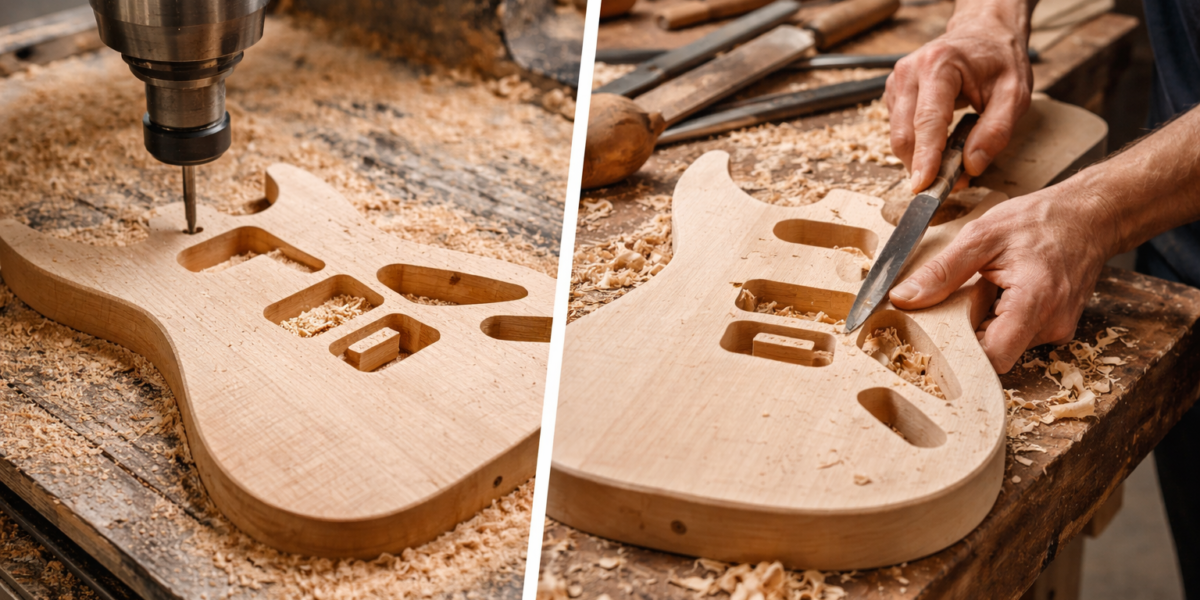
The hand tools vs CNC argument gets emotional fast—but the practical answer is simple:
Use each method where it performs best.
Great guitars are built by good decisions, not ideology.
Short Version
- CNC wins at repeatable geometry and precision routing
- Hand tools win at tactile refinement and final feel
- Best modern builds are usually hybrid workflows
Step-by-Step: What Benefits Most From Each
1) Body Outline and Rough Profiling
Best with: CNC
Why: fast, repeatable, accurate, efficient material use.
Hand tools still useful for: edge breaking, contour refinement, final ergonomic tweaks.
2) Neck Pocket and Bridge Position Geometry
Best with: CNC
Why: tiny alignment errors here cause huge downstream problems (action/intonation/playability).
This is one of the strongest use-cases for machine precision.
3) Fret Slot Cutting
Best with: CNC (or precision jigs)
Why: scale accuracy and slot consistency are critical and measurable.
4) Neck Carve and Profile Feel
Best with: hybrid
- CNC for repeatable baseline carve
- Hand shaping/scraping for final feel and transitions
Why: players feel neck nuance more than they can describe it.
5) Fretwork (level, crown, polish)
Best with: hand tools (skilled hands)
Why: this is high-sensitivity correction work based on real fret behavior, not just CAD intent.
A great fret job can make a modest guitar feel premium.
6) Nut Work
Best with: hand tools
Why: slot depth, width, and angle need micro-adjustment to real strings and playing style.
This is craftsmanship, not just machining.
7) Binding and Detail Cleanup
Best with: hand tools
Why: visual transitions, edges, and cleanup require judgment and finesse.
8) Finish Work
Best with: mostly hand process
Even spray systems and controlled environments still depend on technique and patience:
- prep quality
- coat control
- leveling
- buffing discipline
Finish quality is where rushed builds get exposed.
9) Setup and Final Voicing
Best with: hand tools + ear + player feedback
Relief, action, pickup height, intonation, and resonance balancing are final instrument-making steps.
No CNC routine replaces this stage.
Where CNC Is Most Overrated
- “CNC = better tone” (not automatically)
- “CNC = no hand skill needed” (false)
- “CNC build = no setup required” (absolutely false)
CNC gives a cleaner starting point. It does not finish the instrument.
Where Hand-Only Is Most Overrated
- “Hand-only = always better” (not true)
- “Machine precision kills soul” (romantic, not technical)
- “Any handwork is craftsmanship” (quality still varies)
Handwork without process control can mean inconsistency, not artistry.
Best Workflow for Most Builders
- CNC for high-consequence geometry (pockets, routes, slot locations)
- Hand refinement for neck feel, fretwork, nut, finish, final setup
- Tight QC at each stage
This approach typically gives the best ratio of:
- consistency
- efficiency
- playability
- craftsmanship
For Buyers: What to Ask Instead of “CNC or Hand?”
Ask this:
- How do you handle fretwork?
- How do you cut and dial nut slots?
- How is final setup done?
- What are your QC tolerances?
- Can you explain your process from rough cut to final play test?
Those answers matter more than tool tribalism.
Bottom Line
CNC and hand tools are not enemies.
CNC handles repeatable precision.
Handwork handles musical refinement.
When a builder uses both intentionally, you usually get the strongest result: guitars that are accurate, playable, and full of personality.