
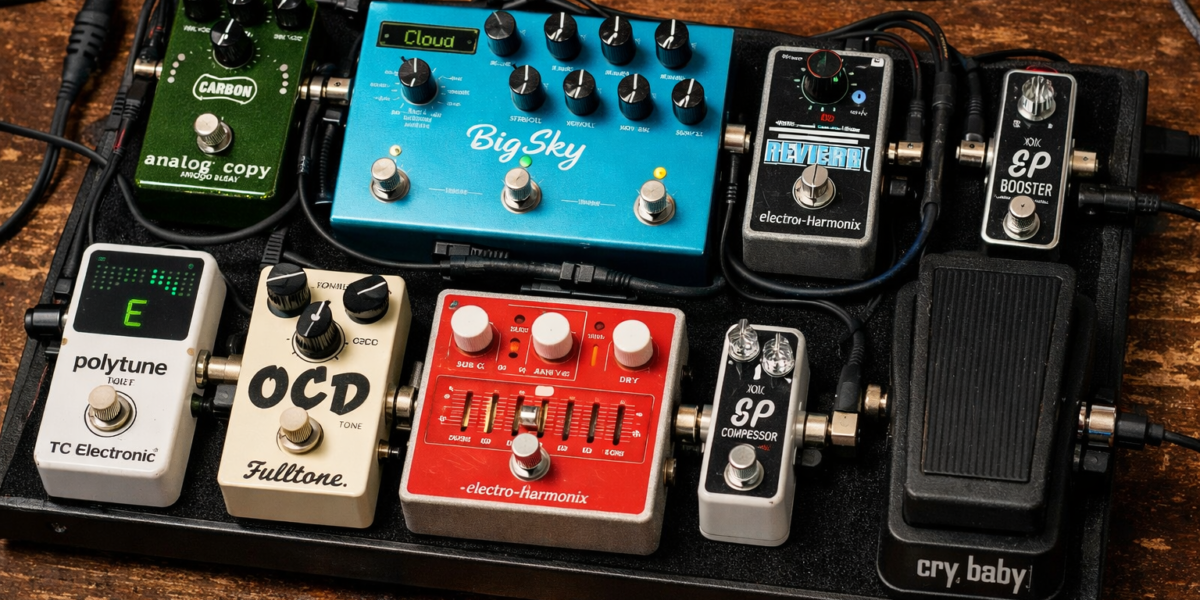
A first pedalboard should solve real musical problems, not impress Instagram.
With about $300, you can build a compact, flexible board that works for clean, crunch, and lead tones without turning into a noise factory.
The Goal (Under $300)
Cover these basics:
- tune silently
- shape gain
- add time-based depth
- keep noise manageable
- stay easy to troubleshoot
You do not need seven gain pedals and a spaceship power rig.
Core 4-Pedal Budget Board
1) Tuner pedal
Why: silent tuning + quick mute on stage.
2) Overdrive
Why: edge-of-breakup, rhythm push, lead boost.
3) Delay
Why: width, sustain, solo space, ambient utility.
4) Reverb (if amp has no good reverb)
Why: depth and polish, especially at lower volume.
If your amp already has great reverb, skip this pedal and use budget for better power supply/cables.
Example Budget Split
- Tuner: $40–$70
- Overdrive: $40–$80
- Delay: $50–$100
- Reverb: $50–$100
- Patch cables + board base: $20–$40
Total target: ~$250–$320 (used market makes this easy)
Best “First Board” Signal Chain
Guitar → Tuner → Overdrive → Delay → Reverb → Amp
Simple, reliable, and easy to diagnose.
If your amp has an FX loop:
- put delay/reverb in loop for cleaner repeats in high gain setups.
New vs Used: Where the Value Is
For first boards, used pedals are often the best value:
- lower cost
- easier resale
- more room for trial-and-error
Just test:
- switch reliability
- jack noise
- power behavior
- bypass function
Don’t Blow Budget on These Early
- boutique hype pedals
- expensive board case before your layout is stable
- giant isolated PSU for 3–4 low-current pedals (start modest, upgrade later)
- niche effects you’ll use once a month
Spend on core tone and clean wiring first.
Power Supply Reality
Cheap daisy chains can work for basic boards, but they can introduce noise with digital pedals.
Starter rule:
- if noise appears, upgrade power before replacing pedals
- clean power often improves everything at once
3 Great Board Variations Under $300
A) Classic Rock/Blues
- Tuner
- Overdrive
- Delay
- Optional boost (or amp reverb)
B) Indie/Worship Clean Platform
- Tuner
- Transparent drive
- Delay
- Reverb
C) Punk/Alt Simplicity
- Tuner
- Mid-forward overdrive/distortion
- Short delay (optional)
- Skip reverb if amp already works
Setup Tips That Make Cheap Boards Feel Pro
- Keep patch cables short and solid
- Label power and signal direction
- Mount pedals with room for foot access
- Set gain low first, then increase
- Match output levels when toggling pedals
A well-leveled board sounds more expensive than it is.
Common First-Board Mistakes
- stacking too much gain
- buying duplicate pedals with same function
- ignoring tuner quality
- not checking pedal levels against bypass signal
- blaming pedals when amp EQ is the real problem
Upgrade Path (After You Learn the Board)
Once you’ve gigged/practiced with this setup:
- add compression or modulation (not both at once)
- upgrade power if noise appears
- replace one weak-link pedal at a time
- keep what you actually use
Bottom Line
A great first pedalboard under $300 is totally realistic.
Keep it simple:
- tuner
- one gain pedal
- delay
- reverb (if needed)
That setup covers most real-world playing better than a bigger, messier board.