
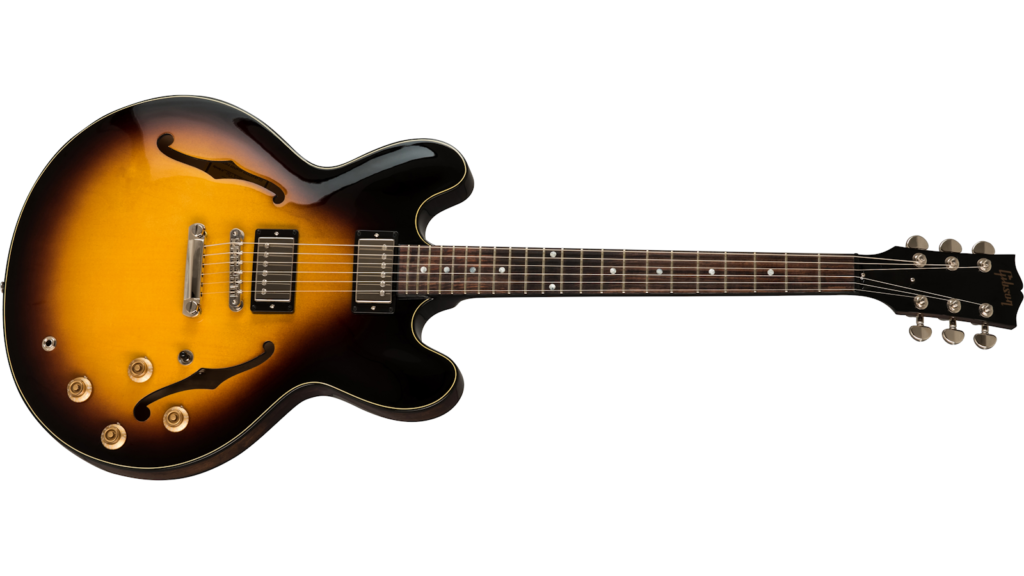
The Gibson ES-335 is one of the most influential and revered electric guitars ever made. Introduced in 1958, it revolutionized the guitar industry by blending the warm resonance of hollow-body guitars with the sustain and feedback resistance of solid-body instruments. This innovative semi-hollowbody design has since become a staple for blues, rock, jazz, and fusion musicians.
Origins and Development
The Need for Innovation
During the 1950s, guitarists were looking for an instrument that could offer the best of both hollow-body and solid-body designs. Hollow-body guitars, popular with jazz and blues players, were prone to feedback at high volumes, whereas solid-body guitars like the Gibson Les Paul had great sustain but lacked the woody resonance of hollow guitars.
The solution came in the form of the Gibson ES-335, the first commercially successful semi-hollowbody electric guitar. Designed by Ted McCarty, it introduced a solid center block running through the body, reducing feedback while still preserving the warmth of a hollow guitar.
Construction and Features
Body Design
The ES-335 features a double-cutaway body shape, which allows easy access to the higher frets. The combination of a laminated maple top, back, and sides contributes to its articulate tone and bright attack. The solid maple center block is the key element that controls feedback while enhancing sustain and resonance.
Neck and Fingerboard
The ES-335 is traditionally built with a mahogany neck and a rosewood fingerboard, offering warmth and smooth playability. The neck profile has varied over the years, from the thick “baseball bat” necks of the late ’50s to the slimmer profiles introduced in the ’60s. Most modern ES-335s feature a comfortable medium rounded-C or slim-taper profile.
Pickups and Electronics
The ES-335 is equipped with humbucking pickups, typically Gibson’s PAF (Patent Applied For) pickups in early models, known for their clear and dynamic response. Later models have used variations like the ’57 Classics, Burstbuckers, or T-Type pickups. The standard ES-335 configuration includes:
- Two humbuckers (neck and bridge positions)
- Three-way pickup selector switch
- Two volume and two tone controls
Some variations, such as the ES-345 and ES-355, introduced stereo wiring and Varitone circuits, adding tonal versatility.
Bridge and Tailpiece
Most ES-335 models feature a Tune-O-Matic bridge with a stopbar tailpiece, providing solid tuning stability and sustain. Some early models and custom variations include Bigsby vibratos, giving them a distinctive aesthetic and additional expressive capability.
Sound and Playability
The ES-335 delivers a balanced tone with a rich midrange, making it incredibly versatile. Some defining characteristics include:
- Warm and articulate clean tones – Great for jazz and blues.
- Fat, singing sustain – Ideal for lead guitar work.
- Crunchy overdrive – Perfect for rock and blues-rock styles.
- Feedback resistance – Unlike fully hollow guitars, the center block allows higher gain settings without excessive feedback.
Notable players like B.B. King, Chuck Berry, Eric Clapton, Larry Carlton, and Dave Grohl have demonstrated the ES-335’s ability to cover diverse genres, from blues to hard rock.
Notable Players and Influence
Blues and Jazz
- B.B. King – While best known for his modified ES-355 (“Lucille”), King helped establish the ES-series guitars as blues icons.
- Larry Carlton – Nicknamed “Mr. 335,” Carlton’s fusion and jazz phrasing showcase the guitar’s versatility.
Rock and Blues-Rock
- Chuck Berry – Often associated with an ES-335 or similar models, Berry’s riffs defined early rock and roll.
- Eric Clapton – Used an ES-335 during his Cream and solo years, capturing its sustain-rich blues tones.
Modern Players
- Dave Grohl – Plays a custom Gibson DG-335, a signature model inspired by the ES-335 with unique modifications.
- Noel Gallagher – Famous for using an ES-335 during his time with Oasis, bringing its warm crunch to Britpop.
Variations and Special Models
Over the decades, Gibson has introduced several variations of the ES-335 to cater to different players’ needs:
- Gibson ES-345 – Introduced in 1959, featuring stereo output and a six-position Varitone switch.
- Gibson ES-355 – A more luxurious version with gold hardware and an ebony fretboard, often with stereo electronics.
- Gibson ES-339 – A modern take with a smaller body, appealing to players who prefer a more compact semi-hollow guitar.
- Gibson Custom Shop & Artist Models – High-end, historically accurate recreations of vintage models, including Eric Clapton’s Crossroads 335 and the Trini Lopez signature model.
Why the ES-335 Remains a Classic
The Gibson ES-335 has remained one of the most sought-after guitars due to its:
- Versatility – Covers jazz, blues, rock, and beyond.
- Unique Tonal Character – A perfect blend of hollow-body warmth and solid-body sustain.
- Timeless Design – A beautifully crafted guitar with classic aesthetics.
- Playability – Comfortable neck profiles and smooth fret access make it a joy to play.