
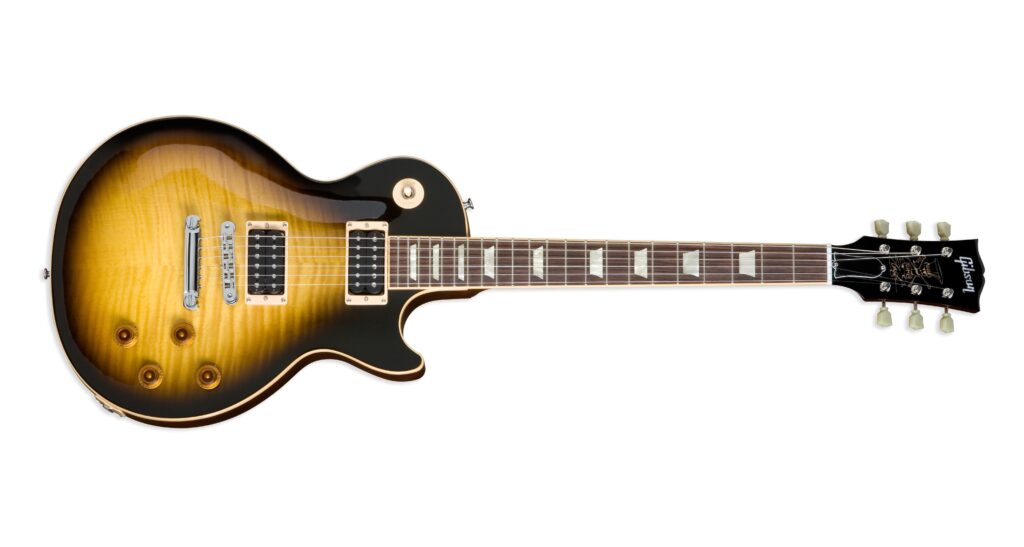
The Gibson Les Paul is one of the most revered and influential electric guitars in history. Introduced in 1952, it was designed in collaboration with jazz guitarist Les Paul and has since become a cornerstone of rock, blues, and metal music. With its solid mahogany body, powerful humbucking pickups, and signature sustain, the Les Paul has been the go-to instrument for countless legendary musicians.
1. History and Development
Origins (1950-1952)
During the late 1940s, electric guitars were evolving rapidly, and Gibson sought to compete with Fender’s revolutionary Telecaster (introduced in 1950). Les Paul, a guitarist and innovator, had previously experimented with solid-body guitar designs and proposed the idea to Gibson. After years of development, the first Gibson Les Paul model was introduced in 1952.
The First Model: 1952 Les Paul Goldtop
- Featured a gold finish for a premium aesthetic.
- Equipped with two P-90 single-coil pickups.
- Had a trapeze tailpiece (which was soon replaced due to design flaws).
Evolution of the Les Paul (1953-1960)
- 1953: The trapeze tailpiece was replaced with a wraparound bridge.
- 1954: Introduction of the Les Paul Custom (“Black Beauty”), featuring gold hardware and an all-mahogany body.
- 1957: Gibson introduced humbucking pickups (PAF pickups), solving the hum issues found in single-coils.
- 1958-1960: The Les Paul Standard received a sunburst finish, creating what are now the most valuable vintage guitars in existence.
2. Key Design Features
a. Body Construction
- Solid Mahogany Body: Provides deep, rich tone with excellent sustain.
- Maple Top: Adds brightness and clarity to balance the warmth of mahogany.
- Single Cutaway: Allows access to higher frets.
- Carved Top: Unlike the flat-bodied Fender guitars, the Les Paul has a beautifully sculpted top.
b. Neck and Fretboard
- Mahogany Neck: Increases sustain and warmth.
- Scale Length: 24.75 inches – slightly shorter than Fender’s 25.5″, making it easier to bend notes.
- Fingerboard Choices:
- Rosewood: Warm, smooth tones.
- Ebony (on some models): Crisp attack and luxurious feel.
c. Pickup Configuration
- 1952-1956 Models: Used P-90 single-coil pickups, offering a raw, biting tone.
- 1957-Present: Equipped with humbuckers, reducing noise while providing a warm, powerful sound.
- Switching System:
- Neck Pickup: Warm, smooth, and bass-heavy.
- Bridge Pickup: Bright, aggressive, and cutting.
- Middle Position: Blended tone from both pickups.
d. Electronics and Controls
- Two Volume Knobs (one for each pickup).
- Two Tone Knobs (one for each pickup).
- Three-Way Toggle Switch (Neck, Bridge, or Both pickups).
e. Bridge and Tailpiece
- Tune-O-Matic Bridge: Introduced in 1954 for precise intonation adjustment.
- Stopbar Tailpiece: Enhances sustain by increasing string tension.
3. Evolution of the Gibson Les Paul
The 1960s: Rise to Fame
- In 1961, Gibson temporarily discontinued the Les Paul, replacing it with the SG (initially called the “Les Paul SG”).
- However, artists like Eric Clapton, Mike Bloomfield, and Peter Green helped revive its popularity.
- In 1968, Gibson resumed Les Paul production due to increasing demand.
The 1970s: Hard Rock and Heavy Metal Adoption
- Players like Jimmy Page (Led Zeppelin) and Ace Frehley (KISS) made the Les Paul a staple of hard rock.
- The Les Paul Custom became popular for its elegant binding, gold hardware, and ebony fretboard.
The 1980s-Present: Continued Legacy
- The Les Paul became a dominant force in blues, rock, and metal, played by Slash (Guns N’ Roses) and Zakk Wylde (Ozzy Osbourne).
- Gibson introduced modern versions with chambered bodies, coil-splitting, and active pickups.
4. Famous Players and Their Les Pauls
Jimmy Page (Led Zeppelin)
- Played a 1959 Les Paul Standard on legendary tracks like Whole Lotta Love and Stairway to Heaven.
Slash (Guns N’ Roses)
- His Sunburst Les Paul became a defining image of 1980s rock.
- Used a mix of Gibson and custom-built Les Pauls.
Eric Clapton
- Played a 1960 Les Paul Standard with John Mayall & The Bluesbreakers, helping to define the British blues-rock sound.
Gary Moore (Thin Lizzy, Solo)
- Famous for using Peter Green’s Les Paul, known for its out-of-phase pickup wiring.
Randy Rhoads (Ozzy Osbourne)
- Used a Les Paul Custom to craft his neoclassical metal guitar tones.
Joe Perry (Aerosmith)
- Owns several Les Pauls, including custom models with special finishes and pickups.
5. Les Paul Variants and Modern Versions
a. Les Paul Standard
- The flagship model with humbuckers, carved maple top, and classic aesthetics.
b. Les Paul Custom (“Black Beauty”)
- Features multi-ply binding, ebony fretboard, and gold hardware.
- Originally introduced in 1954.
c. Les Paul Studio
- A more affordable model, stripping away fancy cosmetics while keeping the core Les Paul tone.
d. Les Paul Junior
- A simplified, single-cutaway model with one P-90 pickup, designed for raw rock and blues tones.
e. Les Paul Special
- Features two P-90 pickups and a flat-top body for a more vintage-inspired design.
f. Les Paul Modern and HP (High Performance)
- Incorporates chambered bodies, coil-splitting, and advanced electronics for greater tonal variety.
6. Why the Gibson Les Paul Remains Popular
- Iconic Tone: Thick, warm sustain with excellent dynamic response.
- Superior Craftsmanship: High-quality woods, hand-finished details.
- Timeless Aesthetic: Elegant curves, rich finishes, and luxurious bindings.
- Versatility: Used in blues, jazz, rock, metal, and pop.
- Historical Significance: Played by some of the greatest musicians ever.