
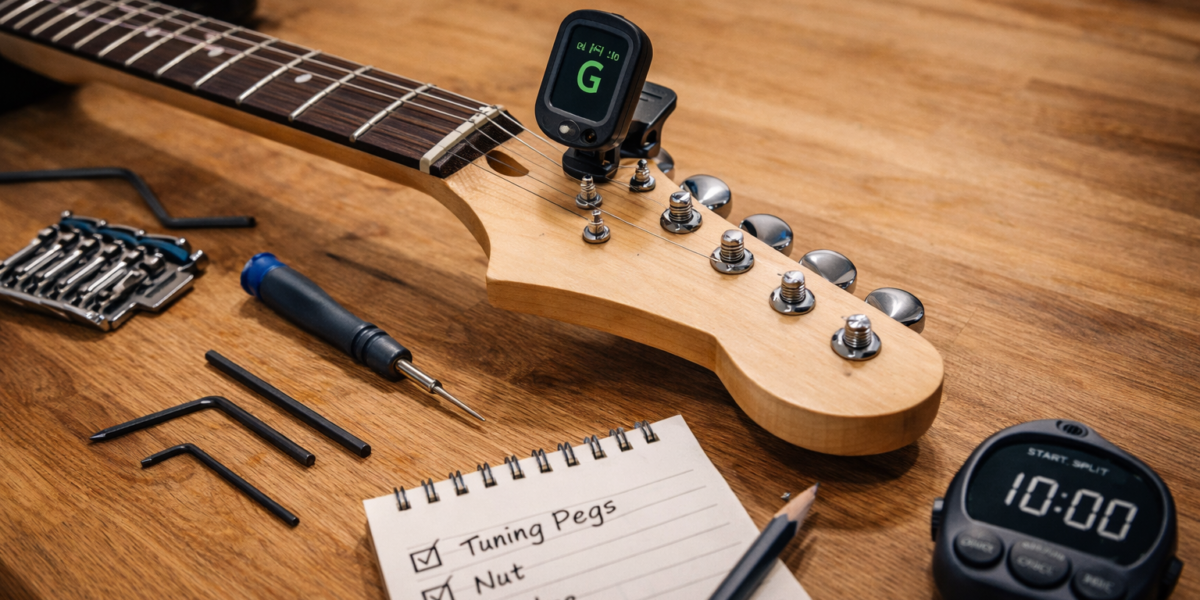
If your guitar won’t stay in tune, don’t start replacing parts blindly.
Most tuning issues come from a few predictable causes, and you can isolate them in about 10 minutes.
What You’ll Need
- Accurate tuner
- String winder (optional)
- Pencil graphite or nut lubricant (optional)
- Screwdriver/hex keys (if needed for quick checks)
Minute 1–2: Rule Out Stringing Errors
Bad string installation causes huge tuning instability.
Check:
- Are strings old/dead?
- Too many or too few wraps around post?
- Wraps neat and downward on tuner post?
- Strings stretched after install?
If strings weren’t stretched, tune up and gently stretch each string along its length, then retune.
Minute 3: Check Where the Drift Happens
This tells you where to look next.
- Goes out mostly after bends/trem use? → suspect nut friction or bridge return
- Goes out gradually while playing normally? → can be tuners, strings, or general setup
- Open strings seem off while fretted notes are okay? → often nut slot issue
- Open strings okay but upper neck sounds off? → intonation/action issue
Minute 4–5: Nut Friction Test
Tune a string exactly.
Then do one of these:
- Bend hard a few times, or
- Use trem lightly and return
Now check pitch:
- Comes back sharp or flat, then “jumps” when tuning key moves?
→ likely nut binding - Hear a “ping” while tuning?
→ strong nut friction clue
Quick temporary test:
- Add tiny graphite (pencil) in nut slot
- Retest
- If stability improves, nut slot friction is likely the culprit
Minute 6–7: Bridge/Trem Test
For trem guitars:
- Check if bridge returns to same resting angle after use
- Verify spring tension balance
- Look for saddle movement or loose hardware
For fixed bridges:
- Check saddle screws/height screws for looseness
- Ensure strings are seated correctly at saddles
If bridge doesn’t return consistently, tuning won’t either.
Minute 8: Tuner Hardware Check
Tuners fail less often than people think, but check anyway:
- Loose tuner mounting screws?
- Loose bushings/nuts at headstock?
- Excess play/slip in a specific tuner?
Tighten hardware gently (not over-torque).
Minute 9: Intonation and Action Sanity Check
This won’t usually cause “drift,” but it causes “sounds out of tune” complaints.
- Compare open note vs fretted 12th
- If way off, intonation needs adjustment
- If action is very high, fretting pressure can push notes sharp
Minute 10: Decision Tree
If tuning jumps after bends/trem → Nut first
If trem won’t return neutral → Bridge balance/setup
If one string only is unstable → That string’s nut slot/saddle/tuner
If everything drifts gradually → Strings/install/environment/setup
Most Common Real-World Causes (in order)
- Improperly installed or unstretched strings
- Nut slot friction
- Trem bridge imbalance
- Loose hardware
- Setup/intonation issues misread as tuning instability
- Actual tuner failure (less common)
What to Fix First (Best ROI)
- New strings + proper install/stretch
- Nut lubrication and slot check
- Bridge/trem setup
- Tighten hardware
- Full setup (relief/action/intonation)
Only then consider replacing tuners or bridge parts.
Bottom Line
“Tuning instability” is usually a setup/friction problem, not a “bad guitar” problem.
Diagnose in order, change one variable at a time, and you’ll fix it faster (and cheaper) than random part swapping.
Related Articles
- Guitar Bridges and Nuts Explained: How They Affect Tone, Tuning, and Playability
- How to Set Up a Steel-String Electric Guitar (Beginner Luthiery Guide)
- How to Clean and Condition a Guitar Fretboard (Without Damaging It)