
The Rickenbacker 330 and 360 are two of the most recognizable and influential electric guitars in music history. With their distinctive semi-hollow body design, chiming tone, and unique aesthetics, these guitars have been the foundation of jangle-pop, rock, and alternative music for decades. Favored by legends like The Beatles, The Byrds, Tom Petty, and Johnny Marr, the Rickenbacker 330 and 360 continue to be celebrated for their bright, articulate sound and unmistakable character.
History and Development
Rickenbacker’s Legacy
Rickenbacker is one of the oldest electric guitar manufacturers, pioneering electrified instruments as early as the 1930s. By the 1950s, Rickenbacker was producing innovative electric guitars with unique body designs, setting them apart from competitors like Gibson and Fender.
The Rickenbacker 330 and 360 were first introduced in the late 1950s as part of the Capri series, designed by luthier Roger Rossmeisl. These guitars became highly sought after in the 1960s British Invasion and the folk-rock movement, cementing their legacy as essential instruments for rock and pop music.
Construction and Features
Body Design and Build
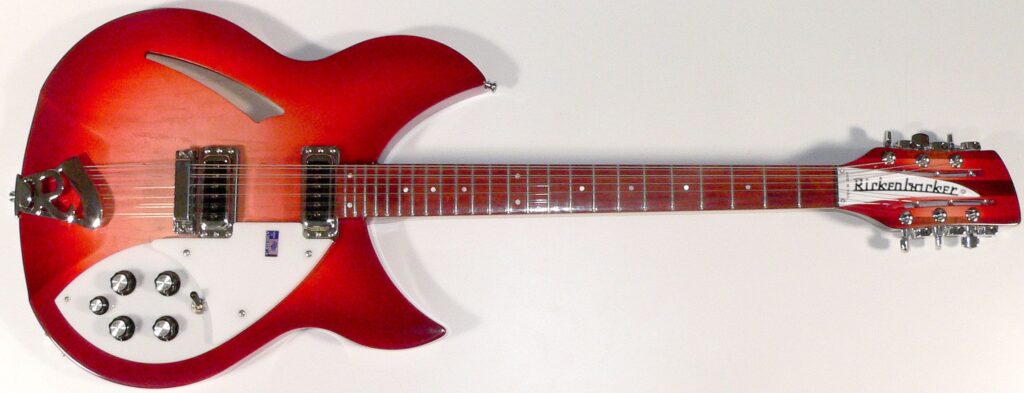
Both the Rickenbacker 330 and 360 are semi-hollow body guitars, crafted from maple, which contributes to their bright, snappy tone. Some key design features include:
- Thinline Semi-Hollow Body – Enhances resonance while reducing feedback.
- Cat’s Eye Soundhole (330) / Bound “Slash” Soundhole (360) – Distinctive openings that help shape the guitar’s unique tonal character.
- Curved (Carved) Top on the 360 – The 360 features a rounded top and back contour for additional comfort.
- Sharp Horn Cutaways – Allows easy access to higher frets, particularly on the 330.
- Double-Bound Body (360) – The 360 features binding along the body and neck for a more refined look.
Neck and Fingerboard
Both models feature a maple neck with a rosewood fingerboard, contributing to their bright tonal response. Other notable neck features include:
- Dual truss rods – Allow precise adjustments to the neck.
- 24.75-inch scale length – Shorter than Fender guitars but slightly longer than Gibson models.
- 21 Frets with Dot (330) or Triangle (360) Inlays – The 330 features simple dot markers, while the 360 has signature “shark fin” inlays.
- Gloss Finish – Provides a smooth playing surface but can feel sticky to some players.
Pickups and Electronics
Rickenbacker 330 and 360 models are known for their signature high-gain single-coil pickups, which deliver a bright, chimey sound with strong midrange presence.
- Rickenbacker “Hi-Gain” Single-Coil Pickups – Deliver articulate highs, crisp attack, and excellent note separation.
- Toaster Top Pickups (Vintage Models) – Earlier 1960s models featured lower-output pickups for a cleaner jangle.
- Blend Knob – A unique fifth knob that adjusts the balance between the neck and bridge pickups, offering more tonal flexibility.
- Two Volume, Two Tone Knobs & Three-Way Toggle Switch – Standard control layout for shaping tone.
Bridge and Tailpiece
- 6-Saddle Adjustable Bridge – Provides better intonation control.
- R Tailpiece (360) or Trapeze Tailpiece (330) – The 360 features an iconic “R” tailpiece, while the 330 has a simple trapeze-style design.
- 12-String Variants Available – Both models are also offered in 12-string versions (330/12 and 360/12), delivering a shimmering, chorus-like effect popularized by The Byrds and Tom Petty.
Sound and Tonal Characteristics
The Rickenbacker 330 and 360 are famous for their crisp, articulate tone with exceptional clarity and jangle. Their semi-hollow design and maple construction create a bright, midrange-focused sound that works well for rhythm playing and arpeggiated chord progressions.
Clean Tones
- Bright, shimmering highs – Signature “jangly” sound, perfect for folk-rock and pop.
- Articulate midrange – Ensures chords and notes remain well-defined.
- Tight low end – Avoids muddiness, making complex chord voicings clear.
Overdriven & Distorted Tones
- Clear note separation – Even with moderate overdrive, the sound remains well-defined.
- Compressed sustain – Rickenbackers naturally compress, making them ideal for rhythm work.
- Vintage-style grit – While not ideal for high-gain tones, they work well for classic rock and punk.
Due to their semi-hollow design, Rickenbacker 330 and 360 guitars can be prone to feedback at high volumes, but this characteristic is often used creatively by players.
Notable Players and Influence
The British Invasion & Classic Rock
- John Lennon & George Harrison (The Beatles) – Lennon used a Rickenbacker 325, while Harrison used a 360/12 for classic Beatles recordings.
- Pete Townshend (The Who) – Early Who records feature his heavily strummed Rickenbacker 330.
- Roger McGuinn (The Byrds) – His 360/12 defined the jangly folk-rock sound of the 1960s.
Alternative & Indie Rock
- Johnny Marr (The Smiths) – Used a 330 for his shimmering, layered chord work.
- Peter Buck (R.E.M.) – Helped define the alternative jangle-rock movement with a 360.
- Tom Petty – His 360/12 became synonymous with his band’s sound.
Punk & New Wave
- Paul Weller (The Jam) – Preferred a 330 for its sharp attack and cutting tone.
- Chris Squire (Yes, Bassist) – While not a guitarist, Squire played a Rickenbacker 4001 bass, helping to cement the brand’s legacy in progressive rock.
330 vs. 360: Key Differences
| Feature | Rickenbacker 330 | Rickenbacker 360 |
|---|---|---|
| Body Shape | More angular, unbound edges | Rounded, bound edges |
| Soundhole | Traditional cat-eye | “Slash” bound soundhole |
| Neck Binding | No binding | Bound neck with triangle inlays |
| Tailpiece | Simple trapeze tailpiece | “R” tailpiece |
| Ergonomics | Slightly sharper feel | More comfortable contoured back |
| Price | More affordable | More expensive due to binding and detailing |
The 330 is a more stripped-down, raw-sounding instrument, while the 360 offers a more refined and smooth playing experience.
Why the Rickenbacker 330/360 Remains a Classic
- Signature Jangle-Tone – No other guitar produces the same level of bright, chimey resonance.
- Timeless Aesthetic – Sleek, futuristic, and unmistakably Rickenbacker.
- Cultural Impact – Essential to The Beatles, The Byrds, and countless others.
- Semi-Hollow Versatility – Great for folk, rock, alternative, and indie music.
- Unique Playability – Shorter scale, tight string spacing, and compressed sound make it special.