
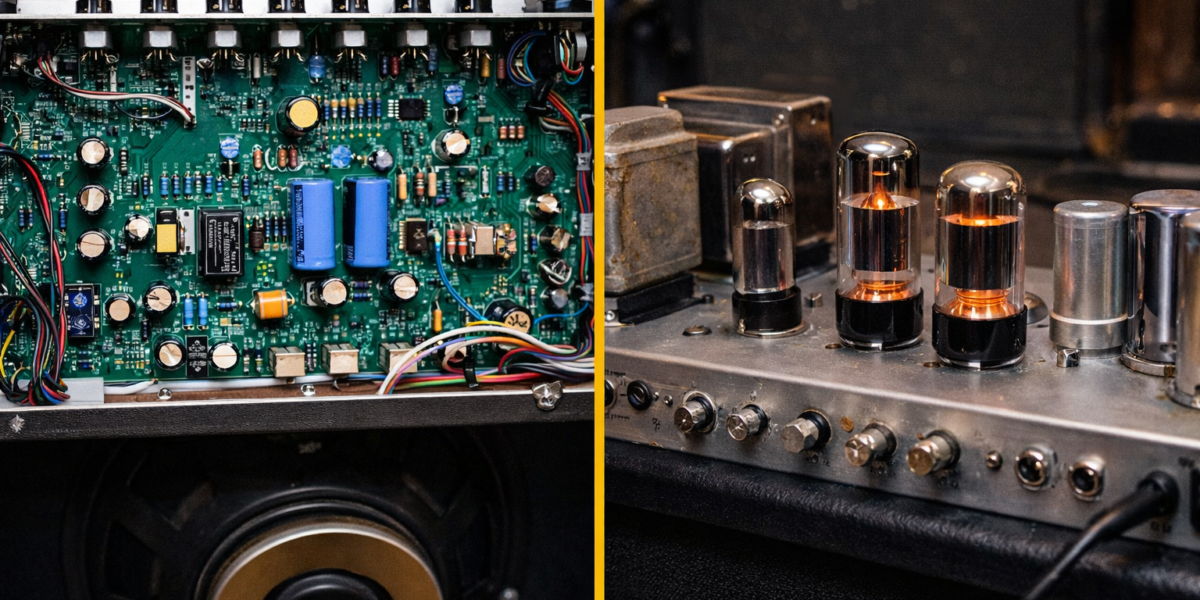
Most players ask, “Which is better: tube or solid-state?”
Wrong first question.
Ask this instead: Where and how will I actually use this amp?
Your environment should decide the technology.
1) Home Practice (Apartment/Bedroom)
Best default choice: Solid-state
Why:
- Better low-volume usability
- Less maintenance hassle
- Usually cheaper and lighter
- Great with headphones/aux features (model-dependent)
Tube can work at home, but many tube amps only “wake up” when louder than your walls can tolerate.
Recommendation:
If 80% of your playing is home practice, solid-state is usually the smarter buy.
2) Home Recording / Project Studio
Best choice: Either, depending on workflow
- Tube: great if you can mic up louder tones and control room noise
- Solid-state: consistent, quick recall, often easier repeatability
If you need predictable sessions at any hour, solid-state often wins on convenience.
Recommendation:
Choose based on workflow speed and noise constraints, not brand mythology.
3) Rehearsal Room
Best choice: Depends on band volume
- Loud drummer + aggressive rock mix: tube and solid-state both viable
- Need clean headroom and consistency: solid-state can shine
- Want responsive pushed-amp feel: tube may feel better
Recommendation:
Test at actual rehearsal volume. Bedroom impressions can mislead badly.
4) Gigging (Bars, Clubs, Regional)
Most practical for many players: Solid-state
Why:
- Less maintenance risk mid-gig
- Lighter carry
- Easier backups
- Consistent night-to-night
Tube still wins for players who build their sound around power-stage interaction and are willing to carry/service accordingly.
Recommendation:
If reliability and portability are top priority, solid-state is hard to beat.
5) Touring / Frequent Transport
Best practical choice: Solid-state or robust hybrid rigs
Frequent transport punishes fragile setups.
If you’re in vans/flights/rough load-ins, lower maintenance and lighter rigs usually save headaches and money.
6) Pedal-Heavy Players
Both work, but:
- Solid-state often offers stable clean platform behavior
- Tube often gives satisfying drive stacking dynamics
If you use lots of modulation/delay/reverb and need consistency, solid-state can be ideal.
7) Budget and Total Cost
Don’t compare purchase price alone.
Include:
- maintenance (tubes/service)
- transport risk
- backup plan cost
- long-term reliability
A cheaper amp that fails at bad times is expensive.
A pricier amp you can’t use at proper volume is also expensive.
Quick Decision Matrix
Pick Tube if you:
- prioritize touch-sensitive breakup feel
- can play at useful volume
- accept maintenance/weight
Pick Solid-State if you:
- need low-volume consistency
- want reliability + portability
- prefer practical, low-maintenance ownership
Common Buying Mistake
Buying with your eyes and forum ego, not your real schedule.
If you mostly play at home and tiny venues, a “dream tube amp” that never leaves standby volume is often the wrong tool.
Final Recommendation
Be honest about your life, not your fantasy rig:
- Where do you play?
- How loud can you actually be?
- How much maintenance do you tolerate?
- How often are you carrying this thing?
Answer those honestly, and your amp choice becomes obvious.